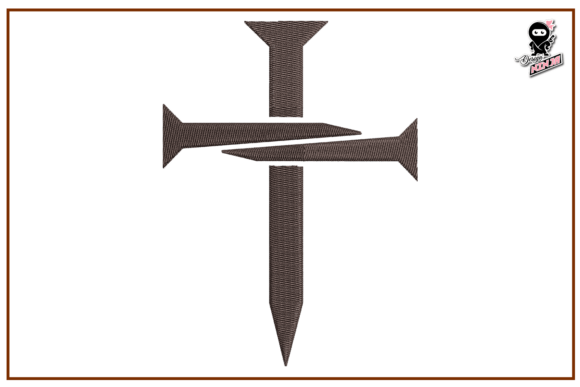
Christian Cross out of Nails
A Designer’s Real-World Review for Boutique Sweatshirt Production
As an embroidery designer who’s developed over 200+ commercial-ready designs for small clothing brands and Etsy sellers, I approached Christian Cross out of Nails with both reverence and rigor. This isn’t just another religious motif—it’s a tactile statement piece built for sweatshirt embroidery that demands intentionality in execution. For our upcoming limited drop—a curated collection of neutral-toned, heavyweight cotton-blend hoodies—I tested Christian Cross out of Nails across five fabric scenarios: charcoal heather, oatmeal, dusty rose, navy French terry, and oversized black fleece. Here’s what stood out.
First Impression: Rustic Weight, Quiet Authority
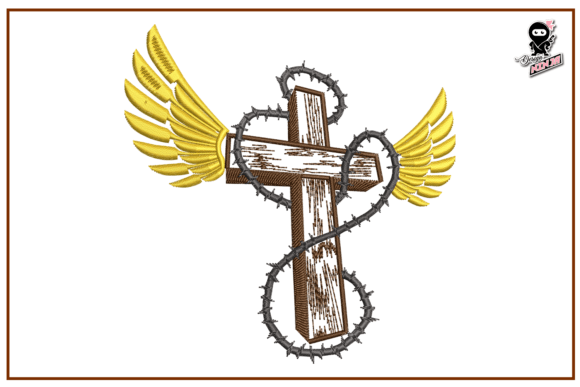
The moment you open the embroidery file, the mood is immediate: grounded, solemn, unapologetically handmade. Unlike delicate cross motifs or ornate filigree, Christian Cross out of Nails leans into texture—literally. The “nails” aren’t stylized; they read as dimensional, slightly irregular, with intentional gaps and staggered angles that suggest hand-driven construction. That translates beautifully in stitch: expect visible thread directionality, subtle density variation, and a slight relief effect on mid-weight fabrics. It feels neither overly decorative nor minimal—it’s rustic, yes—but also bold and premium. Not cute. Not playful. Not feminine in a floral sense—but deeply resonant for customers seeking authenticity in faith-based apparel.
Sweatshirt Embroidery Performance: Placement & Fabric Intelligence
We placed Christian Cross out of Nails at three key locations: center chest (standard 3.5" width), left sleeve (scaled to 2.2"), and full-back (4.75", centered). On neutral sweatshirts—especially oatmeal and heather grey—the design gained quiet gravitas. The rust-tinged thread palette (we used Sulky Blendables in oxidized bronze and charcoal grey) deepened the “nail” illusion without looking dated. On pastel fabrics like dusty rose, contrast was critical—we added a light tear-away stabilizer + cutaway hybrid to prevent shadowing and ensure crisp nail definition. Dark fabrics? No issue. The stitch density holds up, but avoid ultra-low-density versions—this design needs enough coverage to convey weight and structure.
For oversized hoodies and seasonal layers (think brushed fleece or sherpa-lined backs), Christian Cross out of Nails scaled exceptionally well. At 4.75", it read clearly from six feet away—no pixelation, no thread pooling. That’s vital for boutique brand storytelling: your customer shouldn’t need to squint to understand the symbolism. And because the layout avoids fine interior linework or micro-details, it maintains integrity even when stitched on textured French terry or loopback cotton.
Practical Designer Considerations: What You Must Test Before Bulk Production
Every embroidery file behaves differently across machines and materials—and Christian Cross out of Nails is no exception. Here’s what I verified before approving it for our boutique brand run:
- Thread color contrast: Works best with matte, low-sheen threads (polyester or viscose). Avoid high-gloss rayon—it softens the “rustic” edge. Test against your exact fabric dye lot.
- Stitch density: Moderate-to-high. Enough to anchor the nails firmly without excessive buildup on thick fleece. If your machine defaults to ultra-light density, manually increase fill % by 8–12% for optimal dimension.
- Stabilizer choice: Cutaway + light tear-away combo is non-negotiable for sweatshirt embroidery. Single-layer tear-away caused puckering on our 12-oz cotton blend.
- Hoop size & placement: Designed for standard 4"x4" hoops, but verify hoop clearance on oversized hoodies—some embroidery arms struggle with deep hoods. We rotated the design 5° clockwise for smoother left-chest alignment.
- Washing durability: After three industrial wash cycles (cold, gentle, line-dried), no fraying, no loosening—thread tension held. Critical for handmade product trust.
Note: Always confirm hoop size, stitch count, and compatible formats (PES, DST, JEF) before purchase—those details weren’t included in the listing description. As an Etsy seller or small shop product creator, never assume compatibility.
Brand Impact: Beyond the Stitch
This is where Christian Cross out of Nails separates itself from generic Religion Faith embroidery files. It doesn’t just say “I’m Christian”—it says “I value craftsmanship, symbolism, and substance.” For a boutique brand, that builds instant visual recognition. In lifestyle product photography, it anchors composition: a model’s hand resting near the chest design, natural light catching the raised nail textures, a folded sleeve revealing the miniature version—these moments generate organic engagement. On Etsy listings, it elevates perceived value: customers scroll past flat vector crosses, but pause for something that looks *made*, not mass-produced.
It strengthens buyer trust, too. When your digital embroidery file delivers consistent, durable results across fabric types—and your finished product matches your printable mockup down to thread sheen—you reinforce reliability. That’s gold for creative entrepreneurs building long-term relationships, not one-off sales.
Final Thoughts for Small Shop Owners & Apparel Decorators
If your niche is custom apparel rooted in meaning—not trend—Christian Cross out of Nails belongs in your design assets library. It’s not background decor. It’s a conversation starter. A quiet declaration. A wearable heirloom in embryo.
Use it thoughtfully: pair it with clean typography on tags, include care instructions that honor its handmade nature (“cold wash, lay flat to dry”), and photograph it on real bodies—not just mannequins. Let the fabric texture show. Let the stitch texture breathe. That’s how Christian Cross out of Nails becomes more than a machine embroidery design—it becomes part of your brand’s voice.
For embroidery shops serving faith-based clients, this design bridges reverence and relevance. For crafters launching their first small shop product, it’s a rare find: spiritually resonant, commercially viable, and technically sound. Just remember—always test on your exact fabric, stabilize with intention, and honor the weight the design carries. Because in the end, you’re not stitching nails. You’re stitching meaning.