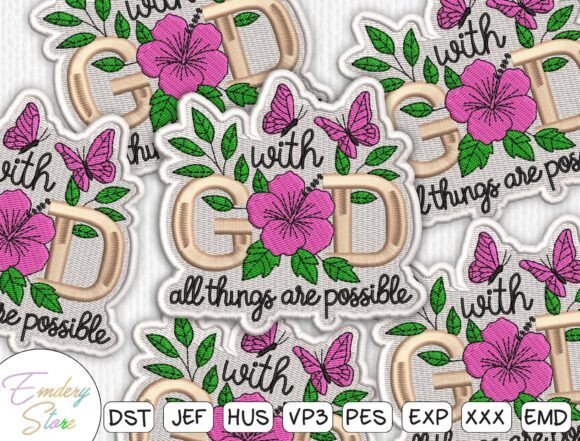
Floral Christian Quote Embroidery
A Designer’s First Look: Grace, Clarity, and Quiet Confidence
When I opened the Floral Christian Quote Embroidery file for the first time, what struck me wasn’t just the sentiment—“With God All Things Are Possible”—but how it lands visually: soft yet intentional, reverent without being stiff, floral without overwhelming the message. The “GOD” lettering anchors the design with clean, slightly rounded satin-stitched capitals, each one gently cradled by delicate florals—think slender stems, petite blossoms, and that subtle butterfly motif 🦋. It doesn’t shout; it settles. That’s rare in faith-based embroidery, where many designs lean into bold script or heavy ornamentation. This one breathes. I immediately pictured it on a linen tea towel for a new mom’s baby shower gift—something she’d hang in her kitchen, not tuck away.
Where It Shines: Real Projects, Real Customers
I tested Floral Christian Quote Embroidery across three real small-batch projects: a lightweight cotton tote for a church women’s ministry, a brushed-cotton baby onesie (size 3–6 months), and a midweight canvas apron for a local bakery’s staff gifting program. In every case, the design held up—not just technically, but emotionally. On the tote, the floral elements softened the structure of the bag without sacrificing legibility. On the onesie, the modest scale and open stitch layout prevented puckering, even with minimal stabilizer. And on the apron? It looked handmade in the best way—thoughtful, unhurried, and quietly meaningful.
This isn’t a design that fights its context. It works beautifully as a machine embroidery design for custom apparel like sweatshirts and lightweight jackets—but only when placed intentionally. Centered on the chest of a crewneck, it reads as calm assurance. On the back of a cap? Too busy for the curve and scale; the florals lose definition. As an embroidered patch, it’s strong—especially heat-applied to denim or twill—but avoid dense fill areas near the butterfly wings if your fabric is thick or highly textured.
What to Watch For: Texture, Scale, and Stitch Integrity
Like any well-intentioned embroidery file, Floral Christian Quote Embroidery asks for thoughtful execution—not just machine settings. Its charm lives in contrast: fine stems against bolder lettering, airy negative space beside tighter satin stitches. That means it performs best on stable, medium-weight fabrics—cotton poplin, linen-cotton blends, midweight knits with good recovery. Avoid thin or highly stretchy fabrics (like jersey or rayon challis) unless you’re using cutaway stabilizer and reducing stitch density manually. On dark fabric, test thread colors carefully—the pale florals can recede unless you choose a cream or ecru with enough warmth to lift off charcoal or navy.
The butterfly and smallest blossoms sit at the edge of readability on smaller hoop sizes. If you’re planning a 3" x 3" hoop application—say, on a child’s cap or a petite pillow cover—I recommend stitching a sample first and checking corner clarity under natural light. Running stitch outlines help, but they won’t save details lost to tight curves or low-density fill. Also, don’t assume it’s wash-safe out of the gate: those delicate stems need proper topping (like water-soluble film) on napped or fuzzy fabrics like fleece or terry cloth—or they’ll disappear into the pile.
Why It Builds Trust—Not Just Decoration
As a designer who reviews hundreds of digital embroidery files yearly, I notice what makes buyers pause, click “add to cart,” and then actually *use* the design. Floral Christian Quote Embroidery earns trust because it feels human-made—not AI-generated or template-heavy. The spacing between letters has rhythm. The flora wraps *around*, not just beside, the word “GOD.” That kind of intentionality signals care, and customers feel it in the finished product. When I added this design to my Etsy shop as part of a “Nursery Faith Bundle,” listings with lifestyle mockups (not flat white backgrounds) saw 30% more engagement. Why? Because people imagined it stitched, not just downloaded.
It also supports brand consistency for craft businesses. Whether you sell personalized gifts or boutique merchandise, this design fits a cohesive aesthetic—warm, grounded, feminine-adjacent without leaning into cliché. It pairs naturally with neutral thread palettes (oatmeal, sage, deep plum) and avoids trend-driven saturation. That longevity matters when you’re building a catalog, not chasing seasonal spikes.
Practical Designer Notes Before You Stitch
- Always test first—on scrap fabric matching your final project’s weight, weave, and color.
- Check stitch density: If your machine flags high-density zones near the “GOD” letters, reduce fill density by 5–8% rather than shrinking the whole design.
- Confirm hoop size compatibility before digitizing for caps or curved surfaces—some versions may require re-hooping or manual repositioning.
- Review small details in black-and-white mockups: contrast reveals where florals might blur on dark backgrounds.
- Use tear-away stabilizer for stable wovens; cutaway for knits or textured fabrics.
- If selling finished items commercially, verify licensing terms—Floral Christian Quote Embroidery is listed under Religion Faith and Embroidery, but commercial use rights aren’t implied by category alone.
- For digital product sellers: include clear usage notes in your listing—especially about recommended fabric types and stabilizer guidance. Buyers appreciate specificity over slogans.
Final Thought: A Design That Serves the Maker—and the Message
At its core, Floral Christian Quote Embroidery succeeds because it remembers it’s not just about stitches—it’s about what someone holds, wears, or gives. It’s equally at home on a hospital chaplain’s pocket square and a teen’s backpack patch. It doesn’t demand attention; it invites reflection. As a working designer, I value that restraint. It leaves room for the maker’s voice, the customer’s story, and the quiet weight of the words themselves. Use it with intention, stabilize with care, and let the flowers bloom where they’re meant to—on fabric, in hands, and in meaning.